Recent visual imitation learning systems have widely adopted
multi-camera setups with wrist-mounted cameras as the de facto
standard. However, manipulation from a single global view remains
challenging, as the policy should capture fine-grained interaction
details and identify task-relevant regions without local wrist
views. To address this challenge, we present Spatially Conditioned
Diffusion Policy (SCDP), a diffusion-based visuomotor policy that
achieves precise and robust manipulation in a single-camera
setting. Our key idea is that end-effector trajectories can serve
as visual attention anchors that reflect task-relevant regions.
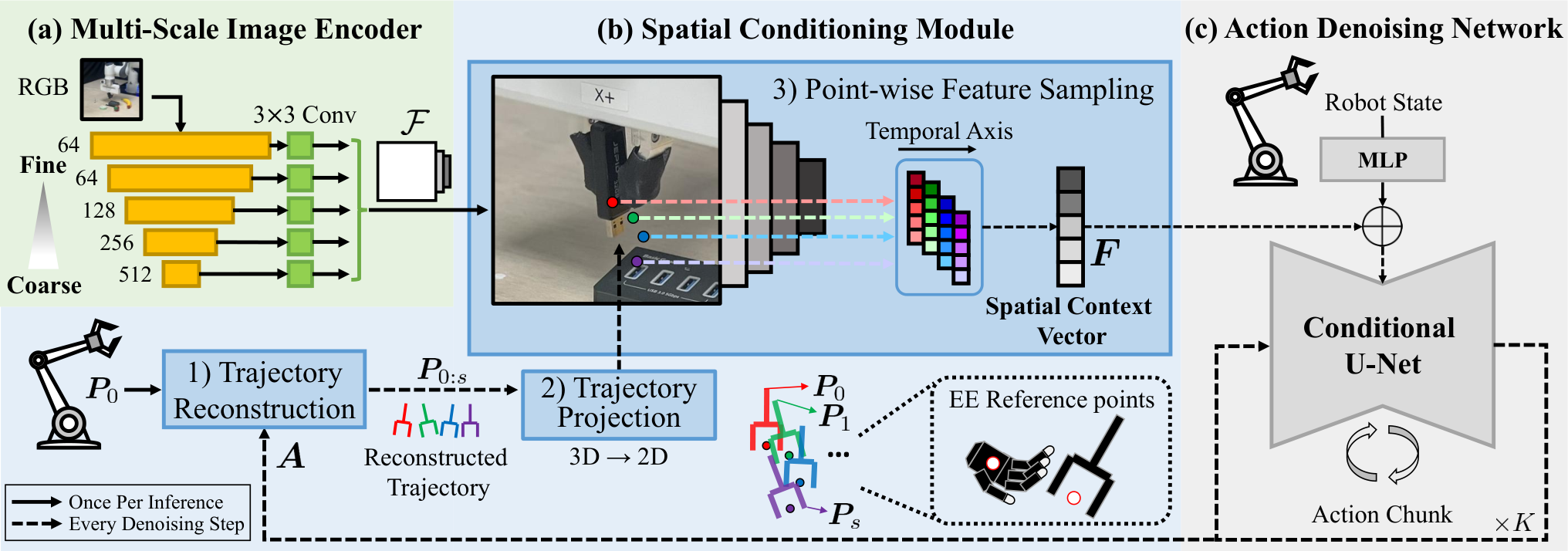
Building on this idea, SCDP consists of two key components: (i) a
visual encoder that produces multi-scale feature maps to capture
both broader context and fine-grained visual features, and (ii) a
spatial conditioning module that samples point-wise features along
intermediate end-effector trajectories in the diffusion loop.
Extensive simulation experiments show that SCDP consistently
outperforms strong single-view baselines and achieves performance
comparable to multi-camera baselines. Real-world experiments
further demonstrate precise manipulation and robustness to visual
distractors, highlighting the potential of single-camera imitation
learning.
Method
Spatial conditioning with visual attention anchors
SCDP architecture
01 / MULTI-SCALE FEATURES
Multi-Scale Image Encoder
Encode a single RGB image into multi-scale feature maps that
capture both global context and fine-grained visual details.
02 / VISUAL ATTENTION
Spatial Conditioning Module
Project reconstructed end-effector trajectories into the image
as visual attention anchors, then sample
point-wise features from multi-scale feature maps at these
locations.
03 / CONDITIONAL DIFFUSION
Action Denoising Network
Condition the action denoising network on the resulting spatial
context through FiLM, updating this context at each denoising
step.
In simulation
Simulation at a glance
Over 80% success across all Meta-World difficulty groups with a single
RGB camera.
Across task difficulty
Meta-World · Success (%) ↑
Single-view competitivenessMeta-World Hard · 6 tasks
Method
Camera setting
Success (%) ↑
DP
+ Wrist RGB
74.2 ± 29.4
DP3
Depth
60.3 ± 38.0
SCDP
Single RGB
82.5± 11.5
Mean ± standard deviation across the 6 tasks.
Experiments
Real-world experiments
Precise and robust manipulation across diverse real-world tasks with
a single RGB camera.
01
Precise Manipulation
Fine alignment and contact-rich insertion, guided by local
visual details.
4× Autonomous
USB Insertion
Grasp the USB drive, align it with the hub port, and push it
into place.
Grasp → Insert → Push
2× Autonomous
Battery Insertion
Align a battery with its slot and overcome spring resistance
to seat it.
Grasp → Insert → Push
02
Distractor Robustness
USB and battery insertion with surrounding visual distractors.
4× Autonomous
USB Insertion w/ Distractors
Insert the target USB drive with other objects in the
workspace.
2× Autonomous
Battery Insertion w/ Distractors
Complete a contact-rich insertion amid surrounding objects.
03
Long Horizon
Sequential manipulation from opening a drawer to putting an
object away.
2× Autonomous
Drawer manipulation
A four-stage manipulation sequence, shown at 2× speed.
01Open drawer
02Pick banana
03Place banana
04Close drawer
04
More Experiments
Cup grasping and cube pushing across different interaction
geometries and distractor settings.
4× Autonomous
Cup Handle Grasping
Adapt the grasp to the handle orientation and pick up the
cup by its handle.
2× Autonomous
Cup Handle Grasping w/ Distractors
Locate the cup handle and grasp it among visually
distracting objects.
4× Autonomous
Cup Wall Grasping
Place one gripper finger inside the cup to grasp its wall
while avoiding the rim and handle.
2× Autonomous
Push Cube w/ Distractors
Push the target red cube with distractor objects in the
workspace.
Additional demonstrations
Humanoid
Humanoid demos
Additional demonstrations using a single head-mounted camera for egocentric visual observation.
2× Autonomous
Separating Paper Cup
A humanoid robot separates paper cups on a tabletop.
2× Autonomous
Erasing White Board
A humanoid robot uses an eraser to wipe a whiteboard.
Reference
Citation
@misc{kim2026scdp,
  title={Spatially Conditioned Diffusion Policy: Learning Precise and Robust Manipulation with a Single RGB Camera},
  author={Seoyoon Kim and Kanghyun Kim and Dongwoo Ko and Young Jin Heo and Min Jun Kim},
  year={2026},
  eprint={2606.14535},
  archivePrefix={arXiv},
  primaryClass={cs.RO},
  url={https://arxiv.org/abs/2606.14535}
}